
Coffee Boxes vs. Coffee Bags: Which Packaging Is Better?
4 min read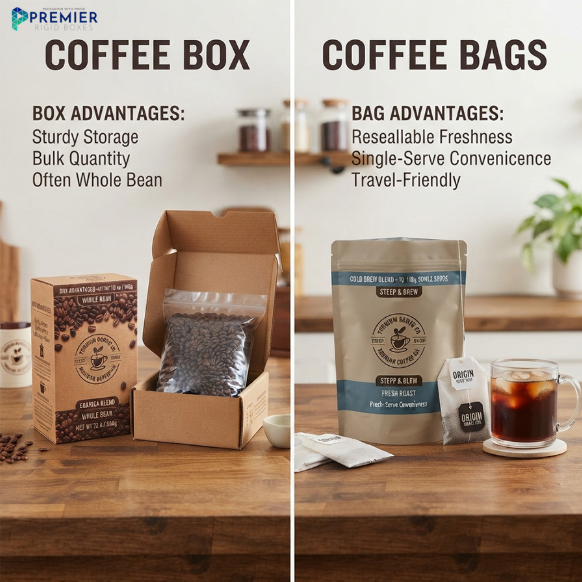
Coffee Boxes vs. Coffee Bags: Which Packaging Is Better?
Every coffee roaster hits this question eventually, usually right around the time they’re ready to sell beyond friends and family. Box or bag? It sounds like a small decision, but it shapes everything from shelf life to shelf presence, and getting it wrong costs more than a reprint fee; it costs stale coffee and customers who don’t come back.
I’ve talked to enough small roasters to know there’s no single right answer here. It depends on the beans, the buyer, and honestly, how much you’re willing to spend per unit. Here’s how the two actually compare, not in theory but in practice.
Freshness Is the Real Battle
Coffee is stubborn about freshness. Roasted beans release carbon dioxide for days after roasting and start losing aroma the moment they’re exposed to air, light, or moisture. Whatever packaging you choose has to manage that, or the coffee inside won’t taste like much by the time it reaches a cup.
Bags, specifically stand-up pouches with a one-way degassing valve, are built almost entirely around solving this problem. The valve lets CO2 escape without letting oxygen back in, which is why bags have become the default for specialty coffee. Freshness is the whole selling point, and bags handle it directly.
Boxes don’t manage freshness on their own. A cardboard box holding loose beans or ground coffee needs an inner liner, usually a foil pouch or a poly bag to actually protect the product. The box itself is more about structure and presentation than preservation. That’s an important distinction a lot of new roasters miss: a custom coffee box looks great, but without a proper liner inside, it’s not doing anything for shelf life.
Where Boxes Win
So if bags handle freshness better, why does anyone use boxes at all?
Presentation, mostly. A rigid box can hold its shape, stack cleanly on a shelf, and carry design details. A flexible bag just can’t have embossed logos, foil accents, a lid that opens like a small reveal. For gift sets, subscription boxes, or premium single-origin releases, that unboxing moment matters. Customers gifting coffee, or buying it as a treat for themselves, respond to that kind of packaging in a way they don’t to a plain foil bag, even a nice one.
Boxes also make more sense for multi-item bundles: a few different roasts, a mug, maybe a scoop where a bag simply doesn’t have the structure to hold everything together.
Where Bags Win
For everyday retail coffee, bags usually make more business sense. They’re cheaper per unit, lighter to ship, and take up less shelf space than a box holding the same amount of coffee. For roasters selling primarily through grocery stores or online subscriptions, that cost difference adds up fast across thousands of units.
Bags also travel better. Less bulk means lower shipping costs, and there’s less risk of crushing during transit compared to a box, which can dent or collapse under weight if it’s not reinforced.
Cost Isn’t Just About the Material
It’s tempting to compare bags and boxes purely on unit price, but that misses part of the picture. A custom coffee box usually needs a liner to protect the coffee, which adds a second cost on top of the box itself. A degassing valve bag, on the other hand, is a single, self-contained unit with no extra liner needed, though the valve itself adds a bit to the base cost of the bag.
When roasters actually run the numbers, bags tend to come out cheaper for high-volume, everyday products, while boxes make sense as a premium add-on for limited releases or gift lines where the margin supports the extra packaging cost.
Branding Looks Different on Each
A logo on a coffee bag usually sits on a printed front panel, which is fine, but it competes with a lot of visual noise if the shelf is crowded. A logo on a custom coffee box has more real estate to work with the lid, the sides, even the inside of the lid if you want a small surprise detail. Roasters trying to build a distinct, recognizable identity on shelf sometimes lean toward boxes for this reason alone, even knowing they cost more per unit.
That said, plenty of well-known coffee brands have built strong identity entirely through bag design. It’s less about which format and more about whether the design is distinctive and consistent across every touchpoint.
So, Which Should You Choose?
If freshness and cost efficiency are the priority, for most everyday coffee sales, bags with a degassing valve are the safer choice. If you’re building a premium line, a gift product, or something meant to be given rather than just consumed, a custom coffee box earns its higher cost through presentation and shelf impact.
Plenty of roasters end up using both: bags for regular retail bags, and boxes reserved for holiday releases, subscription boxes, or limited single-origin batches. There’s no rule saying you have to pick one packaging format for the whole business. Start with what matches your main sales channel, and add the other format later once you know where the extra cost is actually worth it.
About The Author